
Spacing out
The Overview Effect, consciousness, and Bill Nye The Science Guy.

Hi Readers,
First, an apology:
I am overwhelmed with communications and have not set myself up to respond in a timely manner. I really enjoy journalism, and working for multiple organizations has this emergent advantage…and I’m also very underwater. Please forgive me if you are one of the 241 text notifications or 470 email messages to which I have not responded. I am so sorry, and I promise I’ll eventually get to you.
Now to writing.
Some of you might remember that I had (have?) a years-long obsession with outer space policy. It stemmed from a research project in college (2016?) and an internship (2017), and traveled with me when I moved to Baltimore in 2018.
Baltimore was exciting. So many new things to explore! It wasn’t overwhelming, but I would sometimes feel the analysis paralysis of what to do, where to go, who to meet, what to learn, etc. But I knew that the best way I enjoy exploring cities is through a few mediums: food, politics, and passionate people.
Being in close proximity to Goddard, the Applied Physics Lab, the Space Telescope Science Institute, Hopkins, Georgetown, and more, it was a ripe opportunity for me to interview people who were relevant, or at least adjacent, to my curiosities and interests in space policy. So I did.
It took a while – after all, I was doing this in my after-work time. I spoke to astrophysics doctoral students who were tracking meteors from a sailboat in the middle of the the Atlantic ocean; medical students who were thinking about how surgeries could be performed in zero gravity – and remotely, when there’s a 200 second delay in sending video data to/from Earth; professors of space law that could only confirm “good questions” but not offer any guidance on next steps; artists who sought to recreate the overview effect for those of us on Earth; and engineers who worked on JWST and Hubble.
Eventually, this research pursuit led me to the Planetary Society, the now 45-year old organization founded by Carl Sagan to advance humanity’s exploration of the cosmos. The current CEO is Bill Nye The Science Guy (i’m pretty sure that’s his full government name) and, back in 2019, I was trying my damn hardest to interview him. How cool would that have been?
Anyway, fast forward to this last weekend. The Planetary Society recorded an episode of their popular podcast Planetary Radio in front of a live theater audience in Washington DC, and I decided to go. Bill Nye The Science Guy was there (the crowd went nuts. “BILL! BILL! BILL! BILL!”). So was Chief of Space Policy Casey Dreier (who I DID interview in 2019) and Sarah Al-Ahmed, host of Planetary Radio.
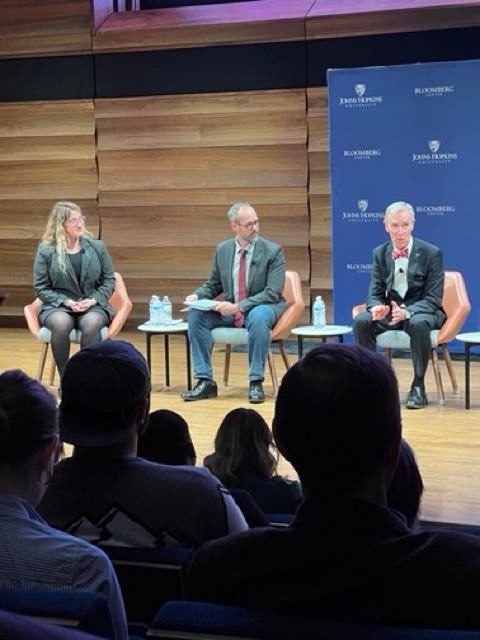
It was fun, had a good time, got to see a friend. Looking back, I wish I had used my press badge to maybe get a personal question or two in.
Thoughts on the event
Yes, obviously the room was going to be biased: we all like space. That also means that room had a higher than average number of people with STEM degrees, belief in science, liberal (this is DC), etc etc.
But what struck me was the way in which we were talking about space and of exploration. Space is this opportunity to bring the world together in awe & wonder. It can bring us together because looking up at the night sky and feeling a sense of how tiny we are in relation to the Universe is almost a universal experience. It’s a practice that is as old as humanity: looking up.
1. The language around the Overview Effect
The Overview Effect is this phenomena that takes place when an astronaut sees Earth from space and recognizes the Oneness of it all. It’s a cognitive shift. From “up” there, one sees that there are no borders (wow, it’s like this applies to so many things), that only the Earth has any noticeable indication of Life (so far), and that any harm that is done against another is only, ultimately, harming ourselves (what a novel concept! /s).
Link from Space Center Houston. Photos that can give you a sense of the Overview Effect.
Here’s an instagram account that shares overhead satellite photos to give you a similar sense.
Anyway, the Overview Effect is essentially us humans in a state of awe. It’s wonder. It’s both remarkable…and frustratingly inexplicable (especially in English). I do not doubt that it is an incredibly overwhelming and powerful experience.
Language around The Overview Effect is oddly similar to how I hear people talk about psychedelics, death, and childbirth. And also, in a different way, artificial intelligence.
“Space is the great equalizer,” Casey Dreier, Chief Space Policy Officer, said.
The common thread I see across these subjects is something around consciousness (or, in the case of AI, lack thereof). By exploring these subjects, it helps us humans understand what it means to be... and to be human. These subjects enable us to study ourselves, and in doing so we realize that there is something remarkable, and inexplicable, about consciousness.
If we were to remove the political motivations from each of these subjects, they very well could all be, in the words of Casey Dreier, the "great equalizers,” in the same way that outer space is. Which leads me to my question: why is space different? Why does outer space still induce this universal feeling in us, but why not birth or death? Why does space enable us to come together, but life or death does not?
(In my opinion, I think this feeling IS induced by birth or death. Just ask any parent or child. But it feels far more localized to the immediate community. It doesn’t have to be though!)
And as we push into outer space and put money and value behind initiatives to explore the cosmos, will this great equalizer (outer space) also become a wedge, much like how AI & psychedelics are//have become?
When I see photos of astronauts looking back down at the Earth, I simply cannot shake the analogy of consciousness looking back on itself.
2. The Overview Effect within a culture
“Space faring is of a cringey earnestness,” said Antonio Peronace, executive director of Space For Humanity, a nonprofit that supports purpose-driven individuals to go to space, personally experience the Overview Effect, and then work towards solving our most pressing challenges on Earth.
I remember learning about the Overview Effect in high school because outer space exploration was the Policy Debate topic for the year. I wondered why it took going to outer space to appreciate the interconnectedness and Oneness of the Earth. After all, aren't we always grounded to the Earth? Does it really take an "othering" – seeing ourselves as separate from – the Earth to recognize that our wellbeing is inherently connected?
Or is the overview effect a phenomenon because we – western, capitalistic, individualistic, competitive, white, patriarchal spaces – exist in a culture of separation? Is it because we think of ourselves as individuals, as nationalities, as armies, as borders, as competing interests within a zero sum game? (I notice this in my ecosystem building work; people think what I'm talking about is radical, revolutionary, and fresh....but it's only because we are so steeped in this culture of individualism that any notion of interdependence, feminist leadership, indigeneity, or relational being is seen as foreign…and often hostile).
Frankly, I think it’s because of the latter. And, again, I think it goes back to consciousness. In our dominant, supremacist culture, we “know” or seek understand things through objectification. We want to leave the subject out of it. Subjective experience is discounted.
“Objectively speaking,” we say. Which is supposed to somehow root the assertion in more Truth?
“It’s all subjective,” we also say. Which then gives us permission to disagree because clearly the subject is nuts.
But if we’re talking about knowing, it inherently HAS to include the subject. In fact, any sort of objectification is the subject objectifying the object. If the subject isn’t there, then what even is the object?
Again, think of the astronaut looking back on Earth.
3. Colonization
You knew this one was coming.
“Space exploration is one of the most noble pursuits of mankind,” Representative George Whitesides said. Whitesides was former CEO of Virgin Galactic. Prior to that, he was the Chief of Staff at NASA. Clearly a smart dude.
So when does language around exploration get into the domain of repeating the mistakes of the past? If we go back 500 years, European royal courts were talking about the exploration, and exploitation, of the New World in a similar way as to how we talk about “exploring,” colonizing, and expanding into the cosmos. And back then, as it is now, the ventures are led by straight, white men with too much time and money on their hands. I'm curious what space exploration would look like if it was led by women (especially matriarchs), indigenous peoples, and trans folks. Would we celebrate celestial bodies differently? What if the Outer Space Treaty included that the “province of outer space” was for all womankind? All beings? All Life-kind?
(My) Needs
Do you know someone who has overseen, or started, an interesting micro-scholarship/micro-grant program? I’d like to chat with them!
Do you know someone who has co-written a book with a more senior, experienced professional? I’d like to chat with them.
Do you know of a creative & simple way that I can source needs from my friends once a month, and then share here?
Are there any templates or systems you have in place for yourself that were helpful in scaling your businesses/operations/responsibilities? I’m especially thinking about small business owners, ADHDers, people whose schedule changes frequently (journalists, e.g.) and people who have a TON of conversations and need to keep notes aligned and organized (also journalists).
Have any ideas for how else I/we can use this collective space & readership? Let me know.
Quotables
“You’re not a slacker if you cut yourself some slack.” – sadly, idk where I heard this. I forgot to write it down!
“Nice thing about deadlines is you learn you can’t be precious about your work.” – (my new friend) Gabby D. is a journalist and said this when I was asking for advice about journalism.
“Whats’s the right temperature for tea? It’s the wrong question and a useless answer.” – Safi Bahcall, Loonshots.
“Generation after generation swells briefly like a wave, then breaks on the shore, subsiding into the anonymous fellowship of death. To find meaning in the mystery of existence is life’s final and fascinating challenge.” – Huston Smith, The World’s Religions.
“You could be sitting next to your blessing, your answer.” – Chef Jasmine Norton, at a Creative Mornings Baltimore event in January.
“He’s a real team player, but he’s the only one playing.” – my cousin Giddhu.
“Remarkable but inexplicable.” – me
What I’m consuming
A lot of chai. Probably too much.
Queso fundido, from Clavel. This is easily my favorite single dish in the entirety of Baltimore. Bubbling hot queso chihuahua (sheeeeeeesh), guacamole, vegetarian frijoles puercos (good lord, how soft and light this is), and totopos. I definitely should not be eating that much cheese. Cheeeesus christ. It’s incredible. Because it’s served in a skillet so the bottom burns ever so slightly. Amazing. And makes me want to befriend restauranteurs.
I think I’ll soon be ready to share this Substack more broadly. But in the meantime, if there is someone that you think would enjoy these topics, feel free to pass this on. No pressure.